How to Choose the Best Gym Trampoline for Your Business?
Choosing the right Gym Trampoline can shape safety, customer satisfaction, and long-term business performance. It is not simply a matter of selecting the largest model.
The Health & Fitness Association’s 2024 Global Report recorded approximately 184 million fitness members worldwide. It also reported global industry revenue of about $96.7 billion in 2023. These figures show a growing market, but they do not guarantee success for every facility. Operators must match equipment with class size, training intensity, available floor space, and expected daily usage.
A commercial trampoline should withstand repeated landings, rapid transitions, and constant cleaning. Look closely at frame construction, spring protection, mat quality, weight limits, replacement parts, and warranty support. EN 13219, Gymnastic equipment—Trampolines, provides useful safety and performance requirements for professional equipment. ASTM International also publishes trampoline safety specifications, although buyers must confirm whether a standard applies to their exact product category.
A practical test matters. Stand beside the frame. Check whether it shifts under pressure. Inspect stitching around the jumping mat. Ask the supplier for load testing, material specifications, maintenance guidance, and documented quality controls. A polished product photo proves very little.
Budget remains important. Yet the cheapest trampoline may create higher costs through repairs, downtime, or limited class capacity. This is where many purchasing decisions become too optimistic. Industry reports describe market direction, not your facility’s daily reality. A smaller studio may need quieter equipment and easier storage. A high-volume training center may prioritize reinforced frames and replaceable components. The best choice balances evidence, user experience, supplier credibility, and honest operational planning.
Define Your Business Needs and Trampoline Usage Goals
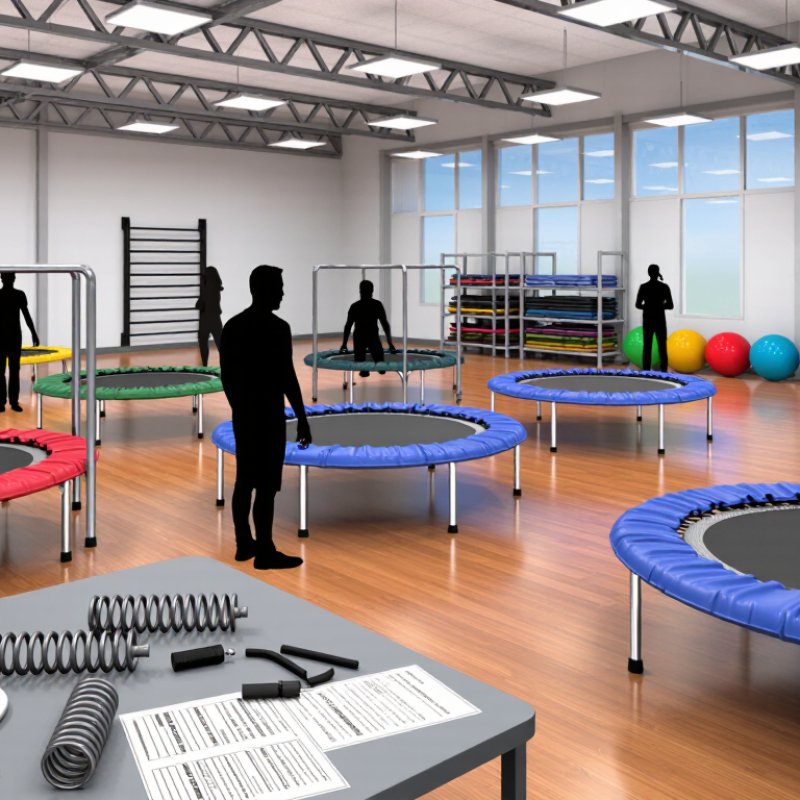
Before comparing gym trampolines, define how your business will use them. A rehabilitation studio needs controlled, low-impact movement and simple height adjustments. A group fitness center may need stronger frames for repeated jumping sessions. A family recreation venue will prioritize padding, visibility, and easy cleaning.
Write down expected users, session length, daily traffic, and available floor space. Measure the training area, including walkways and ceiling clearance. A trampoline that fits the floor may still feel unsafe under low lighting or crowded conditions. Consider whether instructors need to demonstrate exercises beside each unit. That detail often gets missed.
Experience from equipment evaluations shows that usage patterns affect durability more than occasional peak loads. Ask staff to test mounting, storage, and cleaning procedures before purchase. Check frame stability, mat tension, edge protection, and weight guidance against current local safety requirements. Request maintenance instructions and inspection intervals from the supplier. Keep records of these checks.
Do not choose only by price.
Your goal should be measurable. For example, you might need twelve units for forty-minute classes, five days weekly. If the goal is rehabilitation, quieter springs and stable support may matter more than bounce height. If the goal is intense conditioning, ventilation and quick member transitions deserve attention. I once underestimated storage space during a busy class schedule. The equipment worked well, but moving it became awkward. That mistake changed how I assess practical use. Test the routine, not just the trampoline.
Evaluate Safety Features, Materials, and Build Quality
Choosing the best gym trampoline for your business requires more than checking its size and price. Safety features should match daily commercial use. Look for a stable frame, reliable non-slip feet, and padding that fully covers springs or rigid edges. A visible weight rating helps staff manage different users safely. The enclosure, if included, should feel firm and resist sudden movement.
Material quality affects comfort and service life. A tightly woven jumping mat should remain responsive without feeling harsh underfoot. Reinforced stitching matters around high-stress points. Inspect the frame for smooth welds, even coatings, and signs of weak joints. Galvanized or corrosion-resistant metal is useful in humid training rooms. The padding should recover its shape after pressure. Soft padding alone is not proof of protection.
Build quality becomes clearer during hands-on checks. Place the trampoline on a flat floor and test for rocking, noise, or uneven tension. Pull lightly on the frame and watch for unwanted flex. No inspection is perfect. A clean appearance can hide poor internal assembly. I would not rely only on product photographs or a supplier’s claims. Ask for maintenance guidance, replacement-part availability, and documented safety testing. Check bolts after installation, because small looseness can grow through repeated jumping. Staff should record inspections, even when the equipment appears fine. That habit may feel excessive, but missed wear is harder to explain after an incident.
Calculate Total Costs and Select the Best Business Fit
Choosing a gym trampoline for business starts with total cost, not the catalog price. SFIA’s 2024 Topline Participation Report recorded 72.9 million U.S. fitness-facility participants in 2023. That demand rewards equipment that survives frequent sessions. Build a three-year cost sheet. Include the unit, freight, delivery, assembly, floor protection, inspections, cleaning, training, insurance, repairs, and lost revenue during downtime. A cheap frame can become expensive quickly.
Measure room height, landing clearance, class size, and daily jump cycles. Then compare cost per usable session. Divide the three-year total by expected sessions, not advertised capacity. The U.S. Bureau of Labor Statistics reported median annual pay of $46,480 for fitness trainers and instructors in May 2023. Staff time matters. Add setup, supervision, and refresher training to labor costs. Use ASTM F2970-20 as a safety benchmark, while checking local requirements with a qualified inspector.
The best business fit depends on your schedule. A studio running six classes daily needs replaceable springs, washable surfaces, and documented maintenance intervals. A small gym may gain more from one versatile unit than several specialized models. Ask for test records and spare-part lead times. My first spreadsheet usually omits downtime. That mistake is costly. Sensitivity-test attendance at 50%, 75%, and 100% capacity. Include a reserve for repairs. If equipment earns only during peak hours, a lower purchase price may still produce a weaker return.
How to Choose the Best Gym Trampoline for Your Business? - Calculate Total Costs and Select the Best Business Fit
| Equipment Category | Recommended Facility Size | Usable Jumping Area | Recommended Users per Session | Equipment Cost (USD) | Accessories (USD) | Freight (USD) | Installation (USD) | Annual Maintenance (USD) | Estimated 3-Year Total Cost (USD) | Best Business Fit |
| Compact Training Trampoline | Up to 1,000 sq. ft. | Approx. 36 sq. ft. | 1–2 | $2,800 | $450 | $250 | $300 | $180 | $4,340 | Personal training studios, physical therapy rooms, and small fitness centers |
| Small Group Fitness Trampoline | 1,000–2,000 sq. ft. | Approx. 64 sq. ft. | 2–4 | $5,200 | $700 | $400 | $650 | $300 | $7,850 | Boutique gyms and low-volume group exercise programs |
| Commercial Multi-User Trampoline | 2,000–4,000 sq. ft. | Approx. 100 sq. ft. | 4–6 | $9,000 | $1,200 | $650 | $1,100 | $500 | $13,450 | Mainstream gyms offering recurring trampoline-based classes |
| High-Durability Performance Trampoline | 4,000–7,000 sq. ft. | Approx. 144 sq. ft. | 6–8 | $14,500 | $1,800 | $900 | $1,800 | $750 | $21,250 | High-traffic fitness clubs, athletic training centers, and premium studios |
| Large Commercial Trampoline Zone | 7,000+ sq. ft. | Approx. 225 sq. ft. | 8–12 | $23,000 | $2,600 | $1,400 | $2,800 | $1,100 | $38,100 | Large gyms, recreation facilities, and dedicated trampoline fitness zones |
Cost calculation: Estimated 3-Year Total Cost = Equipment Cost + Accessories + Freight + Installation + (Annual Maintenance × 3). Figures are indicative planning estimates in USD and exclude rent, taxes, insurance, staffing, and financing costs.