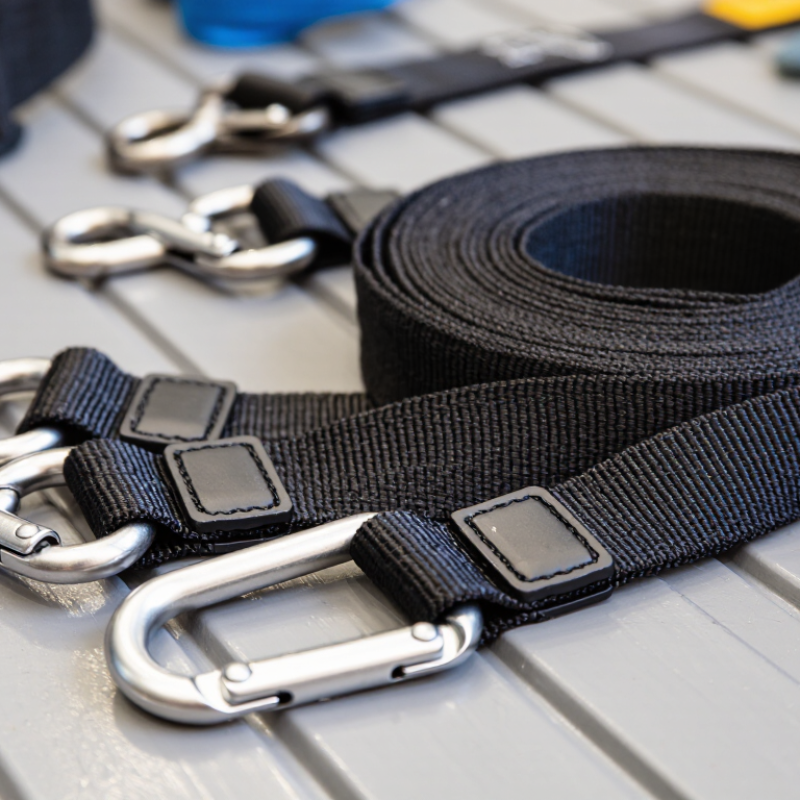
Material
Polyester Webbing | Common choice for Tubular Lanyards | Low moisture absorption compared with nylon; good resistance to sunlight and many common chemicals; typical melting range is approximately 250–260°C. | Advantages: Relatively low stretch, good dimensional stability, and better resistance to ultraviolet exposure than nylon in many outdoor applications.
Limitations: Can be damaged by concentrated acids, molten metal, and sharp edges. | Select for outdoor work, general construction, and situations where limited elongation and weather resistance are important. |
Material
Nylon Webbing | Flexible synthetic fiber option | Higher moisture absorption and generally higher elasticity than polyester; typical melting range is approximately 215–260°C, depending on fiber formulation. | Advantages: Good flexibility, abrasion resistance, and impact absorption characteristics.
Limitations: Strength and dimensions can be affected by moisture; prolonged ultraviolet exposure may reduce performance if not properly stabilized. | Select when flexibility and handling comfort are priorities, provided the lanyard is suitable for the expected wet and outdoor conditions. |
Construction
Tubular Webbing | Woven outer tube with a protected internal structure | The tube-like construction distributes contact over a wider surface than a narrow flat strap and can help protect internal load-bearing fibers from ordinary abrasion. | Advantages: Comfortable handling, good flexibility, and improved resistance to localized rubbing compared with some narrow flat-webbing designs.
Limitations: The hollow or layered appearance does not by itself prove higher strength; certified breaking strength must be checked. | Choose a design with documented tensile strength, stitching quality, edge protection, and inspection instructions. |
Construction
Energy-Absorbing Lanyard | Integrated tear-webbing or controlled-deployment absorber | The absorber deploys during a fall to reduce arrest forces. A compliant design must be tested to the applicable fall-protection standard; for example, ANSI/ASSP Z359.13 limits maximum arresting force to 1,800 lbf (8 kN) for specified energy-absorbing lanyard configurations. | Advantages: Reduces peak forces transmitted to the worker and anchorage when used within the rated system.
Limitations: Deployment consumes webbing length and the lanyard must be removed after a fall or visible deployment. | Use for fall arrest only when the complete system, free-fall distance, clearance, worker weight, and standard certification are suitable. |
Construction
Single-Leg Configuration | One energy-absorbing leg with two end connectors | Provides one connection path between the worker’s harness and an anchorage or connecting point. Typical working lengths are commonly around 1.2–2.0 m, but the exact length must be confirmed on the product label. | Advantages: Simple, lightweight, and suitable where continuous connection is not required.
Limitations: The user may need to disconnect temporarily when moving between anchorage points. | Select where the work area has a clear, nearby anchorage and movement between connection points is limited. |
Construction
双肢 / Twin-Leg Configuration | Two legs joined to one energy-absorbing element | Allows one leg to remain connected while the other is moved. Both legs must not be intentionally connected to separate anchorages unless the manufacturer and applicable instructions specifically permit that configuration. | Advantages: Supports continuous connection during transitions between anchor points.
Limitations: Heavier and more expensive than a single-leg design; unused legs must be managed to avoid snagging. | Select for climbing, structural steel, towers, ladders, and other work requiring frequent movement between anchor points. |
Connection Hardware
Zinc-Plated or Alloy Steel Hook | General-purpose gate connector | Steel hardware typically offers high strength and good wear resistance. Zinc plating can provide corrosion protection, but the coating may deteriorate in aggressive or continuously wet environments. | Advantages: Robust and widely available; suitable for many general industrial applications.
Limitations: Heavier than aluminum and vulnerable to corrosion if the protective finish is damaged. | Choose when durability and cost efficiency are more important than minimum weight; verify gate function and corrosion rating. |
Connection Hardware
Stainless-Steel Hook | Corrosion-resistant hook for demanding environments | Stainless steel provides better resistance to rust and many humid or marine conditions than ordinary plated steel. It remains a metal component and can still be affected by specific chemicals. | Advantages: Improved corrosion resistance and service life in wet or salty environments.
Limitations: Usually heavier and more costly than plated steel or aluminum hardware. | Select for marine work, wastewater facilities, coastal construction, or frequent exposure to moisture. |
Connection Hardware
Aluminum Connector | Lightweight hook or connector body | Aluminum has a high strength-to-weight ratio and is naturally corrosion resistant through formation of an oxide layer, although it is more vulnerable to gouging, deformation, and certain chemical environments than steel. | Advantages: Reduces carried weight and user fatigue.
Limitations: Requires careful inspection for dents, cracks, gate damage, and cross-loading. | Select when low weight is critical, provided the connector’s rated strength, gate opening, and compatibility are adequate. |
Connection Hardware
Self-Locking Snap Hook | Hook with an automatically locking gate | Common gate-opening ranges are approximately 18–25 mm, although the actual opening varies by design. The gate should fully close and lock after loading. | Advantages: Quick attachment and reduced risk of an unintentionally open gate when correctly installed.
Limitations: Must not be connected to incompatible surfaces, webbing, or another connector in a way that causes roll-out or cross-loading. | Select the smallest opening that safely fits the approved anchorage and prevents unintended disengagement. |
Connection Hardware
Rebar or Scaffold Hook | Large-opening hook for structural members | Large-opening hooks commonly provide openings of approximately 50–65 mm, but the exact dimension and allowable attachment locations differ by model and standard. | Advantages: Easier attachment around large structural bars, tubes, and scaffold members.
Limitations: Larger gates can increase the risk of incompatible attachment, edge loading, or contact with nearby structures. | Select only when the anchorage geometry is compatible and the hook can close and lock completely without side loading. |
Safety Check
System Compatibility | Harness, lanyard, connector, and anchorage used as one system | A fall-arrest system must account for the rated user mass, maximum free fall, deceleration distance, harness fit, anchorage strength, swing-fall risk, and total required clearance. | Advantages: Correct system matching reduces misuse and improves predictable performance.
Limitations: A strong individual component cannot compensate for an incompatible or incorrectly configured system. | Confirm the product label, inspection status, applicable standard, connector compatibility, and required fall clearance before use. |