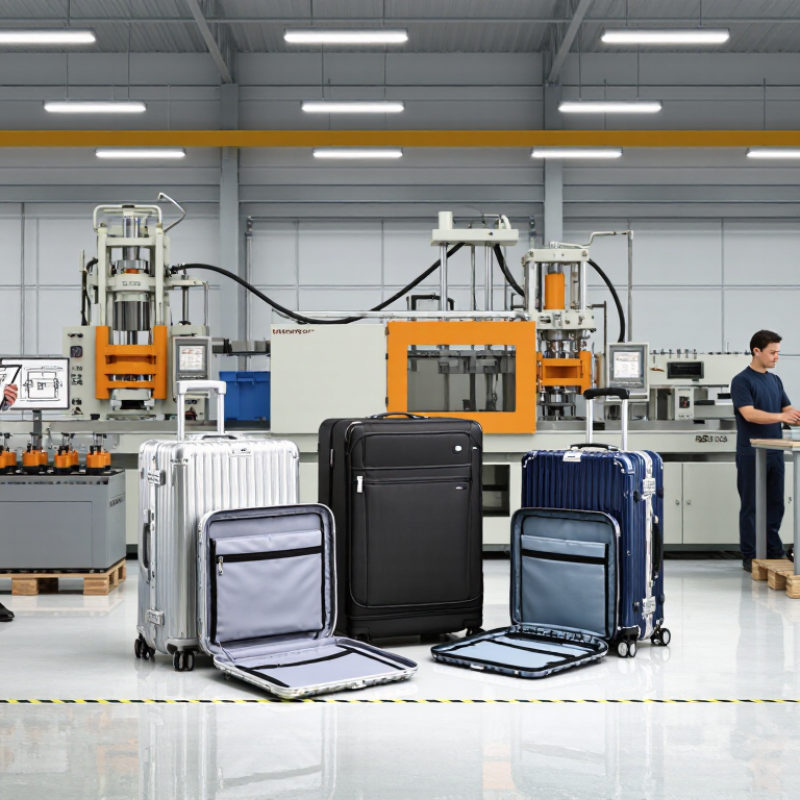
A luggage manufacturer does more than assemble suitcases. It turns a travel concept into a tested, market-ready product. Its work may include design, material sourcing, mold development, stitching, assembly, quality control, and packaging. A reliable factory can explain each stage clearly, from the first drawing to the final carton.
The details matter. Ask whether the shell uses polycarbonate, ABS, aluminum, or another specified material. Check the wheel structure, telescopic handle, zipper strength, lining, corner protection, and lock design. A sample should roll smoothly across tile, carpet, and uneven pavement. Its handle should not wobble after repeated use. Small weaknesses often appear there.
Look for evidence, not confident promises. Review factory experience, production capacity, inspection procedures, relevant certifications, and previous customer markets. Request a physical sample before approving bulk production. Compare its weight, dimensions, stitching, finish, and internal space with your product requirements. Ask how defects are recorded and corrected.
A good luggage manufacturer should also communicate realistic lead times and minimum order quantities. It should clarify tooling fees, material changes, packaging options, and shipping responsibilities in writing. Transparent answers build trust.
The process is not perfectly tidy. Samples may need several revisions. Even experienced suppliers can miss a detail. That is why documented specifications and independent inspections remain valuable. The lowest quotation may hide weaker materials or inconsistent quality. A careful choice balances price, performance, communication, compliance, and long-term reliability. A manufacturer is not merely a production source. It becomes part of your product’s reputation.
A luggage manufacturer is a company that turns design specifications into finished travel cases. It may produce hard-shell suitcases, soft bags, backpacks, or business cases. Unlike a simple reseller, it manages material selection, pattern development, assembly, and quality control. Some manufacturers use their own facilities. Others coordinate approved production partners under documented standards. The label alone proves little. Ask who controls the factory floor.
A capable manufacturer understands how materials behave in daily travel. Polycarbonate shells need balanced flexibility, while fabric cases require dense stitching and reinforced corners. Workers may install wheels, telescopic handles, zippers, and lining by hand or machine. Quality teams should check handle cycles, wheel movement, seam strength, and drop resistance. They should also measure finished dimensions and weight against approved samples. Clear inspection records matter more than attractive factory photographs.
In practical evaluations, request material certificates, production samples, and a description of defect handling. Visit the facility when possible. Watch whether workers follow consistent procedures or rush through visible parts. A manufacturer can claim strong quality and still deliver uneven batches. Samples may look excellent, while later units show loose threads or stiff wheels. No suitcase is indestructible. Even experienced teams misjudge a zipper or underestimate airport handling. Honest manufacturers explain these risks and adjust designs after testing. Their reliability appears in repeatable processes, transparent communication, and evidence that each production run receives real inspection.
A luggage manufacturer does more than assemble suitcases. It develops hard-shell cases, soft-sided bags, backpacks, carry-ons, garment carriers, and travel accessories. Materials may include polycarbonate, ABS, polyester, aluminum, recycled fabrics, and molded components. The right choice depends on durability, weight, target market, and use conditions.
Industry data shows why product depth matters. Allied Market Research valued the global luggage market at about $22.1 billion in 2021 and projected it to reach $31.6 billion by 2031. Its report also identifies travel bags, business bags, and casual bags as important product categories. A capable manufacturer should therefore support several formats, not only one suitcase design. It should explain wheel testing, handle-cycle testing, zipper performance, abrasion resistance, and load capacity in clear terms. Testing evidence matters.
Services often include OEM and ODM development, material sourcing, logo application, prototype production, packaging, quality inspection, and shipment coordination. Some manufacturers also provide color matching, structural redesign, and small-batch sampling. Ask for test records and factory photographs. Ask again if answers seem vague. The International Air Transport Association’s passenger baggage guidance makes dimensions and handling requirements commercially important, especially for cabin luggage. Still, reports cannot replace hands-on evaluation. A sample may roll smoothly on a showroom floor but fail on rough pavement. I once overlooked stitching quality while focusing on shell appearance; that was a costly lesson. Production timelines, defect policies, and communication should be written clearly before large orders begin.
Typical luggage product categories and manufacturer services across the travel-goods industry
Luggage manufacturers commonly develop hard-shell and soft-sided cases in carry-on, checked, and specialty formats. Their services often include product design, material selection, private-label or OEM production, quality inspection, packaging, and after-sales support. The chart shows the relative scope of common offerings for comparison; exact product ranges vary by manufacturer.
A luggage manufacturer turns a travel concept into a tested product. The process usually begins with drawings, measurements, and material selection. Designers consider shell strength, weight, wheel placement, handle movement, and interior capacity. According to Allied Market Research, the global luggage market was valued at about $22.5 billion in 2021. It may reach $39.4 billion by 2031. That growth increases pressure on factories to improve consistency, not only appearance.
Hard luggage often uses polycarbonate or ABS sheets. Machines heat and mold these sheets into precise shell halves. Soft luggage follows a different route. Workers cut coated fabric, stitch panels, and reinforce stress points near handles and wheels. Components then move to assembly, where zippers, frames, locks, bearings, and linings are fitted. A quality team checks dimensions, stitching, wheel movement, and handle alignment. Small errors matter. A slightly uneven wheel can create noise across an airport floor.
Reliable manufacturers also perform drop, load, zipper, handle, and rolling tests. Some use controlled laboratory testing and keep batch records for traceability. The International Trade Centre identifies travel goods as a significant global consumer-goods category, but market reports cannot reveal every factory’s real capability. That is the difficult part. Buyers should request recent test records, production samples, material specifications, and factory audit evidence. A polished sample is not enough. Manufacturing can still vary between batches. Regular inspections and clear acceptance standards reduce that risk, although they never remove it completely.
| Evaluation or Process Dimension | What It Means | Typical Data or Industry Practice | Why It Matters | Recommended Verification |
|---|---|---|---|---|
| Manufacturer Type | A luggage manufacturer converts materials and components into finished products, either for its own collection or for external buyers. | Common operating models include OEM production, where the buyer supplies specifications, and ODM production, where the manufacturer provides an existing design that can be customized. | Identifies how much design, engineering, and production support the buyer can expect. | Ask for a clear description of design ownership, tooling responsibility, customization limits, and production capabilities. |
| Product Category | The type of luggage being developed or produced. | Typical categories include soft-sided luggage, hard-sided luggage, carry-on cases, checked-size cases, travel bags, backpacks, and specialized cases. | Different categories require different materials, machinery, testing methods, and assembly skills. | Review samples that closely match the intended product structure and size. |
| Design and Engineering | The stage where appearance, dimensions, structure, components, and production drawings are defined. | Key documents may include technical drawings, material specifications, component lists, color references, tolerance requirements, and approved samples. | Detailed specifications reduce misunderstandings and make quality results more repeatable. | Confirm that the manufacturer can provide prototypes, revision records, and production-ready specifications. |
| Material Selection | The choice of shell, fabric, lining, foam, reinforcement, wheels, handles, zippers, and other components. | Hard cases commonly use polycarbonate, ABS, polypropylene, or blends. Soft luggage commonly uses polyester, nylon, coated textiles, and structural reinforcement materials. | Materials affect weight, impact resistance, abrasion resistance, appearance, cost, and service life. | Request material composition, thickness or denier information where applicable, test records, and pre-production samples. |
| Pattern Making and Cutting | Preparation and cutting of fabric, lining, foam, or other flexible materials according to approved patterns. | Computer-aided pattern systems and cutting equipment can improve dimensional consistency and material utilization. | Accurate cutting supports proper fit, balanced construction, and consistent appearance. | Check seam allowances, cut-piece identification, nesting efficiency, and inspection procedures. |
| Shell Forming | Creation of the rigid outer shell for hard-sided luggage. | Common methods include injection molding, thermoforming, and related plastic-forming processes, depending on the material and product design. | The forming method influences shell strength, surface finish, dimensional accuracy, tooling cost, and production volume suitability. | Review tooling specifications, sample dimensions, surface quality, and shell deformation after testing. |
| Fabric and Panel Construction | Assembly of textile panels, linings, pockets, reinforcement layers, and structural elements for soft-sided products. | Typical operations include sewing, edge binding, reinforcement stitching, foam insertion, piping, and panel alignment. | Construction quality affects load-bearing performance, durability, comfort, and visual consistency. | Inspect stitch density, seam strength, thread trimming, panel alignment, and reinforcement at stress points. |
| Component Installation | Attachment of functional parts such as wheels, wheel housings, telescopic handles, carry handles, zippers, locks, and identification tags. | Components should be matched to the product’s load, geometry, and intended use. Replacement compatibility is also important for after-sales service. | Many user complaints originate from high-stress components rather than the main shell or fabric. | Check component specifications, attachment methods, spare-part availability, and operating smoothness. |
| Assembly and Finishing | Final joining of the case body and installation of internal and external components. | Typical finishing checks include removal of loose threads, cleaning of surfaces, alignment of logos or labels supplied by the buyer, zipper operation, and handle movement. | Finishing directly affects customer perception and helps prevent avoidable defects before shipment. | Use an approved reference sample and a written visual inspection checklist. |
| Quality Control System | The procedures used to prevent, detect, record, and correct product defects. | A practical system may include incoming-material inspection, in-process checks, final inspection, defect classification, corrective actions, and retained samples. | A documented system is more reliable than relying only on final visual inspection. | Request quality procedures, inspection records, defect limits, corrective-action examples, and audit access. |
| Durability Testing | Evaluation of the product’s resistance to repeated use and common handling conditions. | Relevant checks can include wheel rolling, handle cycling, zipper operation, drop or impact testing, seam strength, abrasion resistance, and load testing. | Testing helps identify design weaknesses before products reach customers. | Agree on test methods, test cycles, sample quantities, acceptance criteria, and reporting format before production. |
| Compliance Documentation | Records showing that materials and products meet applicable legal, safety, chemical, labeling, and market requirements. | Requirements vary by destination market and may include restricted-substance controls, packaging rules, labeling obligations, and product-specific testing. | Non-compliance can cause shipment delays, recalls, penalties, or market access problems. | Identify destination-market requirements and request current test reports, declarations, and material documentation. |
| Sampling and Prototype Approval | The process of validating the design and specifications before mass production. | A typical sequence is concept sample, revised prototype, pre-production sample, and approved production reference sample. | Approval at each stage reduces the risk of producing large quantities with incorrect dimensions or materials. | Record every change in writing and retain a signed or otherwise traceable approval sample. |
| Minimum Order Quantity | The smallest order quantity accepted for a product, color, material, or customized component. | MOQ is influenced by tooling, material purchasing, color batches, component orders, production efficiency, and packaging requirements. | A low unit price may not be practical if the required order quantity is too high for the buyer’s sales plan. | Request MOQ separately for existing designs, customized designs, colors, and new tooling. |
| Production Lead Time | The time required to prepare materials, manufacture, inspect, pack, and release an order. | Lead time varies with product complexity, order quantity, material availability, sampling status, factory capacity, and seasonal demand. | Reliable lead-time planning supports inventory control and prevents missed sales windows. | Obtain a written schedule covering approval, material booking, production, inspection, packing, and shipment readiness. |
| Cost Structure | The factors that make up the product price rather than price alone. | Important cost elements include materials, labor, components, tooling, packaging, inspection, development, freight terms, and applicable taxes or duties. | A transparent cost structure makes quotations easier to compare and reduces unexpected charges. | Request an itemized quotation with assumptions, validity period, payment terms, tooling ownership, and packaging details. |
| Capacity and Scalability | The manufacturer’s ability to produce the required volume consistently and increase output when demand grows. | Capacity depends on production lines, equipment, staffing, supplier network, shift arrangements, and quality-control resources. | A suitable factory must support both the initial order and potential future demand without sacrificing quality. | Review production planning methods, capacity evidence, subcontracting controls, and peak-season arrangements. |
| Supply Chain Traceability | The ability to identify the source and movement of materials and components. | Useful records may include supplier details, batch or lot numbers, incoming inspection results, production dates, and shipment records. | Traceability supports faster investigation and corrective action when a defect is discovered. | Confirm how materials are coded, stored, inspected, and linked to finished-product batches. |
| Packaging and Shipping Readiness | Preparation of products for safe handling, storage, and transportation. | Packaging may include protective films, bags, cartons, molded protection, moisture control, carton markings, and palletization where required. | Proper packaging reduces cosmetic damage, contamination, deformation, and shipment errors. | Approve packaging drawings, carton dimensions, packing ratios, shipping marks, and drop-protection requirements. |
| After-Sales Support | The manufacturer’s ability to assist with defects, replacement components, technical questions, and product improvements. | Useful support may include spare wheels, handles, locks, zipper parts, repair instructions, defect analysis, and warranty cooperation. | Effective support can reduce warranty costs and protect long-term product reliability. | Agree on warranty terms, response times, spare-part policy, evidence requirements, and corrective-action procedures. |
| Supplier Selection Result | The overall suitability of a manufacturer for the buyer’s product and business requirements. | Best fit A strong candidate should demonstrate relevant experience, stable quality control, transparent communication, realistic capacity, documented testing, and commercially workable terms. | The lowest quotation is not necessarily the lowest total cost when defects, delays, rework, and warranty claims are considered. | Use a weighted evaluation covering quality, capability, compliance, lead time, cost, communication, and after-sales support. |

| Note: The data in this table describes common luggage-manufacturing practices and evaluation criteria. Exact materials, testing methods, lead times, minimum order quantities, and compliance requirements vary according to product design, destination market, order volume, and applicable regulations. | ||||
Choosing a luggage manufacturer requires more than comparing factory prices. Durability should be tested under realistic travel conditions: loaded wheels, repeated handle pulls, zipper cycles, and corner drops. SITA’s 2024 Baggage IT Insights reported 6.9 mishandled bags per 1,000 passengers in 2023. A manufacturer should therefore design for rough handling, not showroom appearance.
Ask for measurable evidence. Check material specifications, wheel abrasion results, shell impact tests, and quality-control records. ISO 2859-1 sampling can support consistent inspections, but paperwork alone proves little. Visit the production line when possible. Look for calibrated equipment, traceable batches, and workers who can explain defect procedures. Small details matter. A loose stitch can become a torn seam after one airport transfer.
Capacity and communication also influence reliability. Confirm minimum order quantities, prototype timing, production lead times, spare-part support, and warranty handling. Sustainable claims need evidence, such as recycled-content certificates, factory energy records, or a product life-cycle assessment. The Global Travel Association’s industry outlooks continue to show strong travel demand, yet demand forecasts can change quickly. Avoid manufacturers who promise unlimited flexibility without production data. A low quote may hide weaker materials or rushed inspection. That mistake is easy to make. Recheck the assumptions before signing.
A reliable luggage manufacturer should prove performance, not merely display polished samples. SITA’s 2024 Baggage IT Insights report recorded 6.9 mishandled bags per 1,000 passengers in 2023. That figure makes wheel strength, seam durability, and handle stability practical buying concerns.
Ask for test records covering drop impact, zipper cycles, wheel abrasion, and loaded handle pulls. Request samples from different production batches, not one carefully prepared case.
Ask for evidence, not adjectives. Check whether the factory uses documented incoming-material inspections and traceable batch numbers. ISO 2859-1 sampling plans can support consistent quality checks, while ISO 9001 certification may indicate controlled processes. Certification alone is not proof.
Audit the actual workshop, including rejected-product areas, calibration labels, and corrective-action records. The Grand View Research luggage market report estimated the global market at about 22 billion dollars in 2023, with strong projected growth. More capacity can also mean faster production and weaker supervision. Do not ignore that risk.
A useful factory trial includes a small pilot order. Measure dimensions, empty weight, wheel noise, alignment, and packing protection. Photograph defects before shipment.
Review the manufacturer’s response time when problems appear. A supplier that admits a recurring weakness may be more dependable than one claiming perfection.
No checklist is flawless. I would still repeat testing after tooling changes, because a good first batch can create false confidence.