
Parallel Spunlace Nonwoven Fabric combines a parallel-laid fiber web with hydroentanglement, a process that uses fine, high-pressure water jets to bind fibers mechanically. The result is a fabric without conventional weaving or knitting. Its performance depends on fiber type, web formation, jet pressure, and finishing—not on the name alone.
In a parallel web, fibers are oriented mainly in one direction. This can give the material different strength and stretch characteristics along and across the sheet. Imagine a lightweight roll feeding through a converting line: small changes in fiber alignment may affect how cleanly it cuts, folds, or absorbs liquid. Cotton, viscose, polyester, and blends can each produce different results. Details matter.
Dr. Behnam Pourdeyhimi, a nonwovens researcher and leader at North Carolina State University’s Nonwovens Institute, is a relevant expert in this field. To avoid presenting an unverified statement as his exact words, this is an editorial paraphrase of a research-informed principle: “Fiber selection, web structure, and bonding must be evaluated together.” That is the useful starting point. It is not a substitute for a verified quotation.
This guide explains how parallel spunlace fabric is made, where its directional structure matters, and which specifications buyers should check. These include basis weight, tensile strength in both directions, absorbency, linting, and surface feel. One caveat: “parallel” can describe web orientation, but product labels do not always reveal the full manufacturing setup. Ask for test data. Then compare samples under real use conditions.
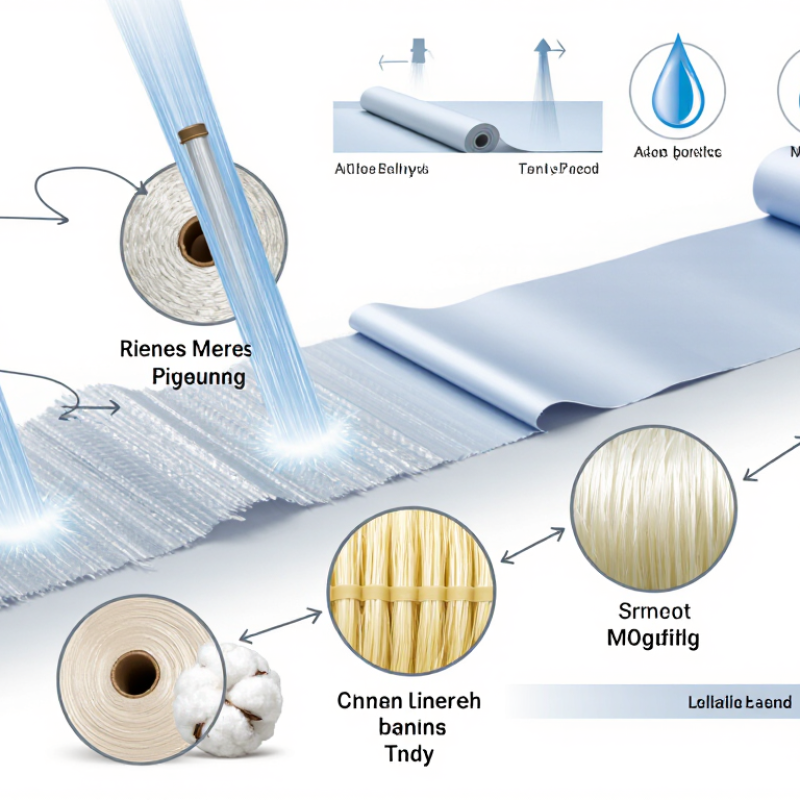
Parallel spunlace nonwoven fabric is a sheet made by arranging fibers mainly in the same direction, then binding them with high-pressure water jets. The jets make fibers loop and interlock, creating a web without relying on woven yarns. No loom is needed. The finished sheet may contain natural fibers, synthetic fibers, or a blend, depending on its intended use.
Its structure has two key features: aligned fibers and mechanical entanglement. Alignment can give the fabric greater strength along the fiber direction than across it. This difference is called directional strength, and it matters when a product is pulled or cut. Water-jet pressure, fiber length, and fabric weight also affect softness, thickness, and absorbency. The surface may feel smooth, but touch alone cannot reveal how evenly the fibers are distributed. It is easy to overstate what “parallel” means; real webs are rarely perfectly aligned.
Tips: Check the product specification for fiber type, weight, and strength in both directions. A small sample test can reveal handling issues that a description may miss.
Typical Hydroentanglement Water-Pressure Ranges
Parallel spunlace fabric is made by directing high-pressure water jets through a fiber web whose fibers are laid predominantly in the machine direction. The jets entangle the fibers mechanically, forming a coherent fabric without adhesive binders. The pressure ranges shown are approximate industry ranges; actual settings vary with fiber type, web weight, and equipment.
Parallel spunlace nonwoven fabric begins with fibers arranged mainly in the machine direction. A carding machine opens and combs the fibers, then deposits them as a thin web on a moving belt. Card settings, fiber length, and feed consistency affect how evenly the strands lie. Small shifts can leave thin streaks that show up later as weak spots. The web is not woven; its fibers remain loose until water jets entangle them.
In hydroentangling, fine, high-pressure water jets strike the web over a perforated support. The jets push fibers around and through neighboring fibers, creating a flexible sheet without a thermal binder. Water is extracted, filtered for reuse, and the fabric is dried. Operators adjust jet pressure and line speed to balance strength, softness, and web damage. There is no single setting that fits every fiber blend. EDANA’s 2023 European nonwovens statistics reported production of about 2.6 million tonnes, showing the scale of the sector in which consistent web formation matters. That figure covers nonwovens broadly, not parallel spunlace alone. A useful check is to inspect the wet web under steady lighting; uneven areas can be difficult to notice once the fabric is dry.
What Is Parallel Spunlace Nonwoven Fabric?
How Water Jets Bond the Fibers
Parallel spunlace fabric begins as a thin web of fibers laid mainly in the machine direction. “Parallel” describes this arrangement, not the bonding method. The loose web travels over a perforated belt while fine water jets strike it from above. The water pushes fibers through the web and loops them around neighboring fibers, creating mechanical entanglement. No adhesive is needed.
Jet pressure and nozzle spacing depend on the fiber blend, web weight, and desired softness. Technical references, including Russell’s Handbook of Nonwovens (2007), describe hydroentanglement as a high-pressure process; operating pressures commonly fall within roughly 30–200 bar. The web may pass under several jet bars, sometimes from both sides. A vacuum beneath the belt draws water away. Too little energy can leave weak spots; too much may damage fibers. The settings are a balancing act.
The scale of the industry gives this process context. EDANA and INDA’s Worldwide Outlook for the Nonwovens Industry 2023–2028 reports global nonwoven production of about 13.8 million tonnes in 2023; that figure covers all nonwoven technologies, not spunlace alone. Parallel webs can offer strength along their fiber direction, but they may feel less uniform across the width. Real production is rarely perfectly tidy. Small changes in web alignment or jet flow can show up as visible streaks.
| Process or Feature | What Happens | Effect on the Fabric | Important Control Factors |
|---|---|---|---|
| Parallel web formation | Fibers are formed into a web with most fibers oriented in the machine direction. The web may be made from staple fibers or continuous filaments. | The fabric tends to have different strength and stretch in the machine direction and cross direction. | Fiber type, fiber length, web weight, and degree of fiber alignment. |
| Web preparation | The loose web is supported on a porous belt or drum and is commonly wetted before intensive hydroentanglement. | Support and even wetting help the web remain stable as water jets act on it. | Web uniformity, support-screen design, water distribution, and line speed. |
| Water-jet entanglement | Fine, high-speed water jets pass through the web. Their energy moves and loops fibers around neighboring fibers, mechanically entangling them. | The web gains cohesion without relying on weaving or knitting; the process does not require a chemical binder to create the entanglement. | Jet pressure, nozzle spacing, water flow, number of manifolds, support pattern, and web speed. |
| Multiple jet passes | The web may pass under several jet manifolds, sometimes with treatment from both sides. Each pass adds or redistributes fiber entanglement. | More extensive treatment can improve web integrity and influence softness, surface texture, and strength. | Treatment sequence and energy must be matched to fiber type, web weight, and desired fabric properties. |
| Water removal and drying | Vacuum extraction removes much of the process water, and the entangled web is then dried. | The finished fabric becomes easier to handle and can be wound or further converted. | Water-removal efficiency, drying conditions, and fabric tension. |
| Common fiber choices | Depending on the product, webs may use fibers such as viscose, polyester, polypropylene, cotton, or blends. | Fiber choice affects absorbency, strength, softness, drying behavior, and suitability for different end uses. | Fiber properties and blend proportions should be selected for the intended application. |
| Typical applications | Hydroentangled fabrics are used in products such as wipes, hygiene materials, medical and personal-care components, and some filtration or industrial products. | The appropriate fabric depends on required absorbency, strength, linting, softness, and other product specifications. | Final performance requirements, regulatory needs, and converting method. |
What Is Parallel Spunlace Nonwoven Fabric? Key Properties and Performance Factors
Parallel spunlace fabric is made by laying fibers mainly in one direction, then entangling them with high-pressure water jets. This creates a sheet without conventional weaving or added binders. Its directional structure can give it good strength along the fiber lay, but lower strength across it. The difference matters when a wipe is pulled, folded, or used on a rough surface. Softness, thickness, and absorbency also depend on fiber type, web weight, jet pressure, and finishing.
Look closely at both directions. A useful specification reports tensile strength and elongation in machine and cross directions, rather than giving one strength figure. The EDANA 2023 European nonwovens statistics report approximately 2.88 million tonnes of total production across nonwoven technologies. That figure is industry context, not a performance guarantee for spunlace. For product checks, ISO 9073 methods cover properties such as tensile strength, thickness, and absorbency. Small changes in fiber blend or water-jet energy can alter results. Too much jet energy may tighten the web and reduce softness; too little can leave weak spots. One caveat: lab measurements do not always predict how a damp sheet feels in hand. Test the finished fabric under its intended use conditions.
Parallel spunlace nonwoven fabric starts with fibers laid mainly in the machine direction, then bonded by fine, high-pressure water jets. The process creates a soft, flexible sheet without traditional chemical binders. Its parallel fiber layout can provide useful lengthwise strength, though cross-direction strength may be lower. That difference matters when a wipe is pulled from a dispenser or a gown moves across the shoulders.
Common uses include cleaning wipes, personal-care sheets, medical textiles, and some apparel components. Material choice depends on the job: viscose supports absorbency, polyester improves strength, and cotton offers a familiar natural-fiber feel. Blends can balance these qualities, but they do not solve every performance issue. INDA and EDANA’s 2023 Global Nonwoven Markets report estimated global nonwoven production at about 13.5 million tonnes in 2022, showing the scale of this material category. For a specific fabric, compare basis weight, absorbency, wet tensile strength, lint, and surface feel—not just fiber content. There is no universal best blend. I still find cross-direction strength easy to overlook.
Tips: Test a finished sample under real use. A dry swatch may feel excellent, then stretch or shed when wet. Check both fabric directions before setting a specification.